
Packaging Fundamentals · Box Measurement
Length, Width, and Height Dimensions: The Complete Guide to Measuring a Box
The L × W × H convention, volume formula, dimensional weight rules, and shipping carrier reference with two interactive calculators to solve your box math instantly.
Key Takeaways
- →
The common convention for box dimensions is Length × Width × Height (L × W × H), measured in the same unit throughout. - →
Length = longest base side · Width = shorter base side · Height = vertical measurement from base to top. - →
Volume = L × W × H. Use it to calculate cubic size and dimensional weight for shipping. - →
Dimensional weight = (L × W × H) ÷ divisor. As of publication, UPS and FedEx use 139 domestically; USPS Priority Mail uses 166. Carriers bill the greater of DIM or actual weight. - →
Use internal dimensions for product fit; use external dimensions for shipping cost and storage planning.
Quick Answer
Box dimensions are commonly written in the order Length × Width × Height (L × W × H). Length is the longest side of the base, width is the shorter base side, and height is the vertical measurement from base to top. For a box measuring 16 × 12 × 12 inches, the volume is 2,304 cubic inches. This dimensional information is essential for accurate product fit, shipping cost calculation, and warehouse space planning.
Why Box Dimensions Matter
A box is more than a container. It is a shipping cost, a shelf position, a warehouse footprint, and a customer’s first impression. Getting the dimensions wrong affects every one of those functions.
Three specific business outcomes depend on accurate box measurement:
- Product protection. A correctly sized box leaves no unnecessary empty space, preventing the product from shifting during transit. Oversized boxes let items rattle and break; undersized boxes crush corners and stress seams. Both drive return complaints.
- Shipping cost efficiency. Major carriers such as UPS, FedEx, and USPS charge based on the greater of actual weight or dimensional weight. A poorly sized package with excess air inside can trigger dimensional weight billing, which often doubles or triples the shipping cost.
- Storage and stacking efficiency. Warehouse cubic footage is expensive. Accurate external dimensions allow efficient pallet stacking, truck loading, and shelf planning, which reduces storage costs at scale.
A one-inch measurement error, multiplied across thousands of shipments, becomes a significant cost problem. Precision is not optional at scale.
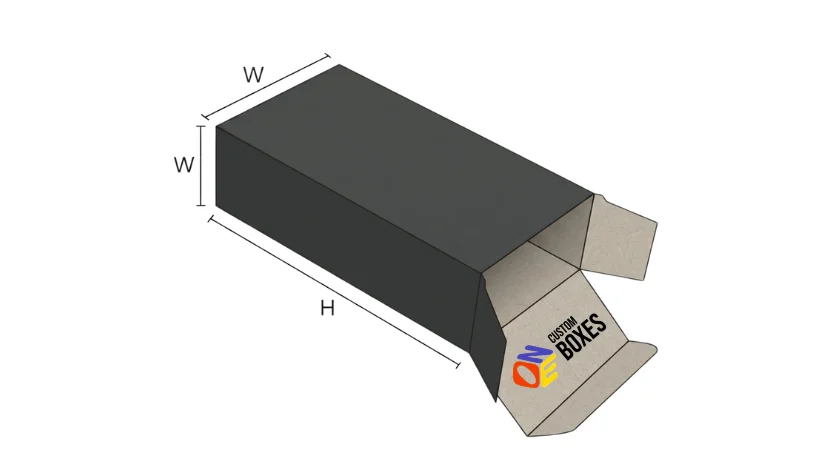
Length, Width, and Height Defined
The three dimensions of any rectangular box are measured at right angles to each other. Each has a specific definition:
| Dimension | Definition | Measured From |
|---|---|---|
| Length (L) | The longest side of the box’s base | Left edge to right edge, horizontal |
| Width (W) | The shorter side of the base, perpendicular to length | Front edge to back edge, horizontal |
| Height (H) | The vertical distance from base to top | Bottom to top, vertical |
Real-world example a standard cereal box:
A typical cereal box measures approximately 7.5″ × 2″ × 12″:
- Length: 7.5 inches the wider face of the box (where the brand name appears)
- Width: 2 inches the shallow depth (side panel with nutrition info)
- Height: 12 inches the tall vertical measurement (top of box to base)
Note: some packaging categories use the term “depth” instead of “height” (especially for shipping mailer boxes and drawer-style boxes). The measurement is the same only the label differs.
The L × W × H Convention
Confusion around box dimension order costs businesses real money. Different industries have occasionally used varied conventions, but for most packaging and shipping applications, one standard is dominant:
Length × Width × Height
(L × W × H)
This is the convention commonly used by:
- Major shipping carriers, including UPS, FedEx, and USPS
- Amazon FBA product listing requirements
- Custom packaging manufacturers and print production
- International trade documentation and customs declarations
- Most warehouse management and inventory software
Important nuance: some product categories, regional manufacturers, and specialty marketplaces do use alternative dimension orders (for example, some furniture and appliance categories list W × D × H). Whenever you place a custom box order or record product dimensions, confirm the convention your specific supplier or carrier expects. In most packaging contexts, L × W × H is the safe default.
How to Measure a Box: Step-by-Step
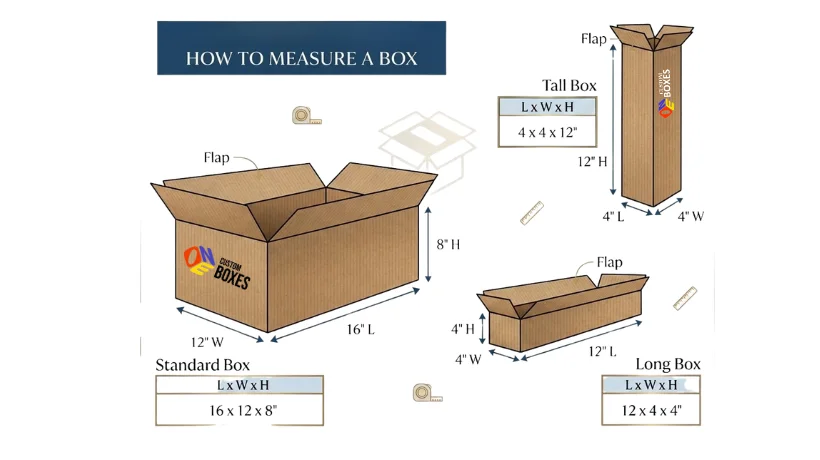
The measurement itself takes under a minute. Doing it accurately requires only that you follow the same order every time.
- Place the box on a flat, level surface. Close all flaps to establish a stable, consistent shape.
- Measure the length. Identify the longest side of the base and measure edge to edge horizontally. Note the value.
- Measure the width. Measure the shorter base side, perpendicular to the length. Note the value.
- Measure the height. Measure vertically from the base of the box to the top edge. Note the value.
- Record dimensions in L × W × H order using the same unit throughout either inches or centimeters.
Important: if you’re checking whether a product will fit inside, measure the internal dimensions. If you’re calculating shipping cost or storage space, measure the external dimensions. The two values differ by roughly the thickness of the box wall typically 2–5mm depending on material.
Box Volume Formula and Calculator
Volume also called cubic size is the total three-dimensional space a box occupies. It’s the number you need for shipping cost estimation, container loading, and warehouse planning. The formula is simple:
Volume = Length × Width × Height
Worked example: A standard shipping box measures 16″ × 12″ × 12″. Its volume is 16 × 12 × 12 = 2,304 cubic inches. That same box in centimeters (40.6 × 30.5 × 30.5 cm) has a volume of approximately 37,730 cubic centimeters or 37.73 liters.
Interactive Box Volume Calculator
Enter length, width, and height to calculate the cubic volume of your box instantly in both inches and centimeters.
Metric equivalent: ≈ 37,754 cm³ (37.75 liters)
Cubic feet: ≈ 1.33 ft³
Dimensional Weight (DIM Weight) Explained
Dimensional weight is one of the most misunderstood elements of shipping and one of the most expensive to get wrong. Carriers charge you based on the greater of two numbers: your package’s actual weight, or its dimensional weight.
The reason is simple economics. A large, lightweight package takes up truck space that a smaller, heavier package could occupy. Carriers recover that lost capacity by billing dimensional weight when it exceeds actual weight.
DIM Weight = (L × W × H) ÷ DIM Divisor
Common Carrier DIM Divisors
The divisors below reflect published rates as of this article’s publication date. Carriers periodically update DIM divisors and rating rules verify current values directly on each carrier’s official rate page before large-volume shipments. Direct links to each carrier’s DIM page are included in the source column.
| Carrier | DIM Divisor (in → lbs) | DIM Divisor (cm → kg) | Notes & Source |
|---|---|---|---|
| UPS (Domestic US) | 139 | 5,000 | Applies to all package sizes. UPS official ↗ |
| FedEx (Domestic US) | 139 | 5,000 | Applies to all package sizes. FedEx official ↗ |
| USPS (Priority Mail) | 166 | 6,000 | Typically applies to packages over 1 cubic foot. USPS DMM ↗ |
| DHL (International) | 139 | 5,000 | Varies by region and service. DHL ↗ |
| UPS / FedEx (International) | 139 | 5,000 | Confirm current rates for your origin/destination pair with the carrier. |
DIM Weight Example
A 16″ × 12″ × 12″ box with actual weight of 5 pounds:
Step 1 Volume: 16 × 12 × 12 = 2,304 cubic inches
Step 2 DIM weight (UPS/FedEx): 2,304 ÷ 139 = 16.58 lbs
Step 3 Billed weight: The carrier bills based on 16.58 lbs (DIM weight), not the 5 lbs actual weight, because DIM is greater.
The result: choosing a smaller, snugger box can meaningfully reduce your shipping bill on identical product weight sometimes by half or more, depending on the shape difference.
Dimensional Weight Calculator
Enter your box dimensions and actual weight to see which weight the carrier will bill, and how much you may be paying for empty space.
DIM Weight Calculator
DIM weight: 16.58 lbs
Actual weight: 5 lbs
Billed weight: 16.58 lbs (DIM weight applies)
Calculator uses the published DIM divisor for the selected carrier. Actual carrier bills may vary based on service class, zone, contract rate, and dimensional rounding rules. Always confirm with the carrier for shipping-cost commitments.
Internal vs External Dimensions
Every box has two sets of measurements the outer size (external) and the inner usable space (internal). The difference is the thickness of the box wall, which varies by material.
| Use Case | Which Dimensions | Why |
|---|---|---|
| Checking product fit | Internal | Reflects actual usable space for the product |
| Custom box manufacturing | Internal | Industry standard for spec sheets |
| Shipping cost calculation | External | Carriers bill by outer package size |
| Warehouse storage planning | External | Determines physical shelf footprint |
| Pallet stacking | External | Affects total pallet load count |
When placing a custom box order, always specify which measurement you’re providing. Reputable packaging manufacturers typically default to internal dimensions unless told otherwise but confirming avoids costly re-runs.
2D vs 3D Packaging Dimensions
Two-dimensional packaging has only length and width no depth. It is used for flat items like photographs, art prints, canvas, and legal documents. Mailing envelopes and rigid document mailers fall into this category.
Three-dimensional packaging has length, width, and height creating a hollow volume that can hold physical objects. Nearly all product boxes, shipping cartons, and retail packaging are 3D. This includes cereal boxes, shoe boxes, cosmetic cartons, and shipping boxes.
The distinction matters for shipping classification. Flat 2D mail is often eligible for lower-cost letter or flat-rate service tiers that don’t apply to 3D packages, regardless of weight.
Common Measurement Mistakes to Avoid
Most box measurement errors trace back to a small number of recurring mistakes. Avoiding these prevents costly production re-runs and shipping surprises:
- Writing dimensions in the wrong order. Height-first, width-first, or random-order dimensions can confuse manufacturers and produce wrong-sized boxes. Default to L × W × H unless the supplier specifies otherwise.
- Mixing units. A single order specifying “12 × 8 × 10 in” and later “24 cm” creates ambiguity. Use one unit consistently.
- Confusing internal and external dimensions. Ordering based on the wrong measurement produces boxes that don’t fit the product or that trigger higher shipping costs than expected.
- Measuring from folded flaps. Always measure with all flaps closed and the box in its final assembled state. Open-flap measurements add error.
- Estimating instead of measuring. Even experienced eyes misjudge by 1–2 cm, which compounds into shipping cost errors at scale.
- Ignoring product packaging inside. If your product is bagged, wrapped, or padded, measure the final packaged size not the bare product.
Tools for Accurate Box Measurement
Accurate measurement doesn’t require expensive equipment. A small toolkit covers nearly every packaging situation:
- Measuring tape. A 10-foot retractable tape handles most box sizes. Look for one with both inch and centimeter markings.
- Ruler. A 12-inch ruler works well for small mailer boxes, cartons under 30 cm, and precise measurements where a tape flexes too much.
- Digital caliper. Useful for measuring material thickness (wall thickness of the box itself), which matters for internal vs external calculations and for specifying material weight.
- Yardstick or meter stick. Useful for large boxes over 24 inches, where retractable tapes tend to sag.
- Notepad or spreadsheet. Record dimensions immediately. Multiple boxes measured in sequence can create memory errors quickly.
The Bottom Line
Box dimensions look simple on paper three numbers, one formula. In practice, they determine your shipping cost, your product’s safety in transit, your warehouse efficiency, and your customer’s unboxing experience.
The rules are consistent: measure in L × W × H order, use one unit throughout, distinguish internal from external, and account for dimensional weight when planning shipping. Whether you’re ordering 100 custom mailers or specifying a 100,000-unit production run, the same principles apply.
Request a custom box quote or contact our packaging team for help spec’ing dimensions that fit your product and minimize your shipping cost.
Frequently Asked Questions
What comes first in dimensions length, width, or height?
In most packaging and shipping contexts, length comes first. The commonly used order is Length × Width × Height (L × W × H). Length is the longest side of the base, width is the shorter side of the base, and height is measured vertically from base to top. Some product categories and manufacturers use different conventions, so confirm with your specific supplier or carrier.
How do you measure the height of a box?
Place the box on a flat surface with all flaps closed and the opening facing up. Measure vertically from the base of the box to the top edge using a ruler or tape measure. For rectangular boxes, height is the dimension perpendicular to both length and width.
What is L × W × H?
L × W × H stands for Length × Width × Height the standard formula for expressing the three dimensions of any three-dimensional object. It is used to calculate volume (L × W × H = cubic size) and to communicate box dimensions across packaging, shipping, and manufacturing industries.
What is the correct order of L × W × H?
The common convention is Length first (longest base side), Width second (shorter base side), then Height (vertical measurement from base to top). This order is used by major shipping carriers such as UPS, FedEx, and USPS, and by most packaging manufacturers. Some marketplaces and product categories use alternative orders, so confirm the convention before ordering.
How do you find the volume of a box?
Multiply the three dimensions: Volume = Length × Width × Height. For example, a box measuring 16 × 12 × 12 inches has a volume of 2,304 cubic inches. Volume is used to calculate dimensional weight for shipping cost estimation and to plan warehouse space.
What is dimensional weight (DIM weight)?
Dimensional weight is a shipping calculation that reflects a package’s volume relative to its actual weight. Carriers charge based on whichever is greater. The formula is (L × W × H) ÷ DIM divisor. As of publication, common divisors are 139 for UPS and FedEx domestic and 166 for USPS Priority Mail. Verify current values on each carrier’s official rate page before large-volume shipments.
Should I use internal or external dimensions of a box?
Use internal dimensions when checking if a product fits inside internal dimensions reflect actual usable space. Use external dimensions for shipping cost calculations, storage planning, and pallet stacking, since carriers charge based on the outer package size.
What is the difference between length, width, and height?
Length is the longest horizontal side of the base. Width is the shorter horizontal side of the base, perpendicular to length. Height is the vertical distance from the base to the top. All three are measured at right angles to each other and typically recorded in L × W × H order.
One Custom Boxes Editorial Team
Packaging & Print Production Content Team
This guide was prepared by the One Custom Boxes editorial team using published dimensional weight formulas and rating rules from UPS, FedEx, and USPS, together with standard practices from commercial packaging production. Content is reviewed against carrier documentation and packaging industry conventions before publication and periodically re-verified against current carrier rate pages.
Read our editorial policy
· Published: February 11, 2025 · Last reviewed: February 11, 2025
References and Further Reading
- UPS Shipping cost and time calculation, including dimensional weight rules. ups.com Calculate Time & Cost ↗
- FedEx Dimensional weight policy, formulas, and calculator. fedex.com Dimensional Weight ↗
- USPS Domestic Mail Manual (DMM) Section 1.a.5 Dimensional weight pricing for Priority Mail. pe.usps.com DMM 1.a.5 ↗
- DHL International package DIM weight and shipping information. dhl.com ↗
- ISO 3394 International standard for the dimensions of rigid rectangular transport packages, referenced in industry documentation for pallet and case sizing.
- Amazon Seller Central FBA product dimension and packaging requirements. sellercentral.amazon.com ↗