
Why Cup and Milliliter Conversions Matter

Kitchen work from casual home cooking to professional baking regularly involves measuring liquid ingredients like water, milk, oil, vinegar, and syrups. In many parts of the world, cups are the preferred everyday measurement unit because they are quicker to work with than multi-digit milliliter values.
Recipes often use casual references like “3 cups of water” or “¼ cup of lemon juice” because these are easier to follow than exact metric numbers. When a recipe uses milliliters instead, or when you are following a recipe from a different country, knowing how to convert between the two units becomes essential for consistent results.
The challenge is that cup sizes are not the same everywhere. A “cup” in a US cookbook is not the same volume as a “cup” in an Australian or British recipe. Understanding these differences prevents small measurement errors that can significantly affect texture, flavor, and cooking outcomes especially in baking, where precision is critical.
What Is a Milliliter (mL)?
A milliliter (mL) is a metric unit of volume used worldwide to measure liquids. It forms part of the International System of Units (SI), which is the global standard for scientific and everyday measurement.
Common items measured in milliliters include:
- Water, milk, juice, and other beverages
- Cooking oil and vinegar
- Syrups and flavoring extracts
- Liquid medicine and cough syrup dosing
- Cosmetic and personal care products
Quick reference:
- 1 liter = 1,000 mL
- 500 mL = half a liter
- 250 mL = quarter liter
Most packaged beverages, bottled liquids, and international food products display their volume in milliliters on the label.
What Is a Cup?
A cup is a unit of volume commonly used in cooking and baking recipes. Unlike the milliliter, which has a single defined value, the cup is not identical across all regions. Different countries use slightly different cup standards, and this variation is one of the most common sources of confusion when following international recipes.
This is why two recipes from different countries can call for “1 cup” of the same ingredient but produce different results the underlying volume is not the same.
Standard Milliliters to Cups Conversion
The most commonly used conversion is based on the US customary cup:
1 US customary cup = 236.588 mL
For everyday kitchen use, this value is usually rounded to 237 mL. The rounding is small enough that it does not affect most recipes, though precise baking may benefit from using the exact value.
Complete ml to Cups Conversion Chart
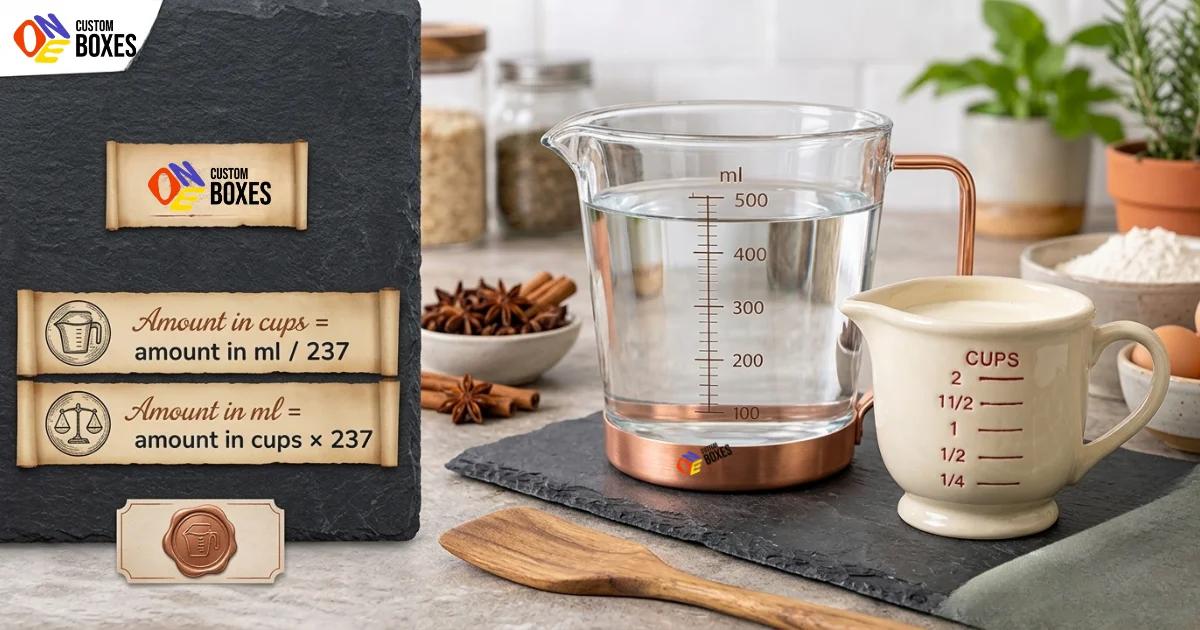
The chart below uses the US customary cup (≈ 237 mL) as the reference. Use this table for quick lookups when following American recipes or when converting bottled liquid volumes into cup measurements.
| Milliliters (mL) | Cups (US Customary) | Common Use |
|---|---|---|
| 59 mL | ¼ cup | Small liquid additions |
| 79 mL | ⅓ cup | Sauces, dressings |
| 118 mL | ½ cup | Standard recipe half-cup |
| 158 mL | ⅔ cup | Batter and baking mixes |
| 177 mL | ¾ cup | Beverages and marinades |
| 237 mL | 1 cup (8 fl oz) | Standard cup measurement |
| 473 mL | ≈ 2 cups | One US pint |
| 500 mL | ≈ 2.11 cups | Half liter bottle |
| 750 mL | ≈ 3.17 cups | Standard wine bottle |
| 946 mL | ≈ 4 cups | One US quart |
| 1,000 mL (1 L) | ≈ 4.23 cups | One liter |
| 1.9 L | ≈ 8 cups | Half US gallon |
| 3.8 L | ≈ 16 cups | One US gallon |
The Fastest Formula for ml to Cups
You do not need to memorize the entire chart. The formula for converting milliliters to cups is straightforward, and it works for any liquid quantity.
Convert milliliters to cups
Cups = Milliliters ÷ 237 (for US customary cups)
Cups = Milliliters ÷ 250 (for metric cups)
Example: Converting 500 mL to US cups → 500 ÷ 237 = 2.11 cups. Using metric cups → 500 ÷ 250 = 2 cups exactly.
Convert cups back to milliliters
Milliliters = Cups × 237 (for US customary cups)
Milliliters = Cups × 250 (for metric cups)
Example: Converting 2.11 US cups back to milliliters → 2.11 × 237 = 500 mL. This confirms the conversion is consistent in both directions.
Global Cup Capacity Standards by Region
The volume of “one cup” depends on where the recipe or measurement standard originates. The five most widely used cup standards are summarized below.
| Cup Standard | Volume (mL) | Where It Is Used |
|---|---|---|
| US Customary Cup | ≈ 236.59 mL | American home kitchens and cookbooks; equals 8 US fluid ounces |
| US Legal Cup | 240 mL | Official US nutrition labels and FDA food packaging standards |
| Metric Cup | 250 mL | Australia, New Zealand, and many international recipe formats |
| Imperial (UK) Cup | ≈ 284.13 mL | Traditional British recipes; equals 10 imperial fluid ounces |
| Japanese Cup | 200 mL | Japanese recipes and rice cookers; equals one-fifth of a liter |
The difference between the smallest (Japanese, 200 mL) and largest (Imperial UK, 284.13 mL) standard is about 42 percent large enough to noticeably affect recipe outcomes when the wrong standard is used. Always check the origin of a recipe before assuming which cup standard applies.
Interactive ml to Cups Calculator
Enter a milliliter value and choose your cup standard to see the exact cup conversion instantly.
Cup size used: 236.59 mL per cup
Reverse check: 2.11 cups × 236.59 = 499.20 mL
Tips for Measuring Liquids Accurately
Good conversion math only matters if the physical measurement is also accurate. The following practices improve consistency in both cooking and baking:
- Use a transparent liquid measuring cup. Clear glass or plastic makes the liquid level visible from the side, which is more accurate than looking down at an opaque cup.
- Place the measuring cup on a flat surface. Holding it in the air introduces tilt, which produces inaccurate readings.
- Read measurements at eye level. Look straight at the marking rather than from above or below. Viewing from above typically causes over-pouring.
- Avoid estimating. Even experienced cooks over- or under-pour when working by eye. Use the correct tool every time.
- Use measuring spoons for small volumes. For quantities under 60 mL (¼ cup), spoons are more accurate than partial cup markings.
- Confirm the recipe’s measurement system. Check whether it uses US, metric, imperial, or Japanese standards before converting.
Common Measurement Mistakes to Avoid
Most kitchen measurement errors trace back to a small number of recurring mistakes:
- Confusing milliliters with grams. Milliliters measure volume; grams measure mass. They are only equivalent for water at standard conditions not for oils, syrups, or thicker liquids.
- Mixing metric and US cups without converting. A recipe designed around 250 mL cups will not behave the same way when measured with 237 mL US cups, especially in baking.
- Estimating instead of measuring. Guess-pouring introduces variation that compounds across multiple ingredients.
- Reading the measuring cup from above. The correct viewing angle is eye level. Reading from above adds visual parallax that leads to over-measurement.
- Using dry measuring cups for liquids (or vice versa). Dry and liquid measuring cups are designed differently. Liquid cups have pour spouts and headroom; dry cups are filled to the rim and leveled off.
Avoiding these mistakes produces more consistent cooking results and reduces the frustration of recipes that “should have worked.”
The Bottom Line
Converting milliliters to cups is a one-time concept that pays off every time you cook. The core rule is simple: divide milliliters by 237 for US cups, or by 250 for metric cups. Once the formula is familiar, any liquid quantity can be translated between units in seconds.
For quick lookups, save the conversion chart on this page or use the interactive calculator above. For unfamiliar recipes, always confirm which cup standard the original author used a small check that prevents most measurement-related recipe failures.