
Standard Playing Card Size: The Baseline
The measurement 2.5 × 3.5 inches sits at the center of the playing card world. This dimension shuffles comfortably in average adult hands, fits universally available card sleeves, and matches the tuck box templates used by nearly every commercial card manufacturer. Casino tables, magic routines, tournament decks, and mass-market card games are all built around this format.
While this size is often described as “universal,” it is more accurately the American poker standard. Continental Europe, Asia, and specialty markets use different formats built around the requirements of specific games and regional traditions. Understanding when to follow the standard and when to deviate is the foundation of any good card design decision.
Complete Playing Card Size Reference
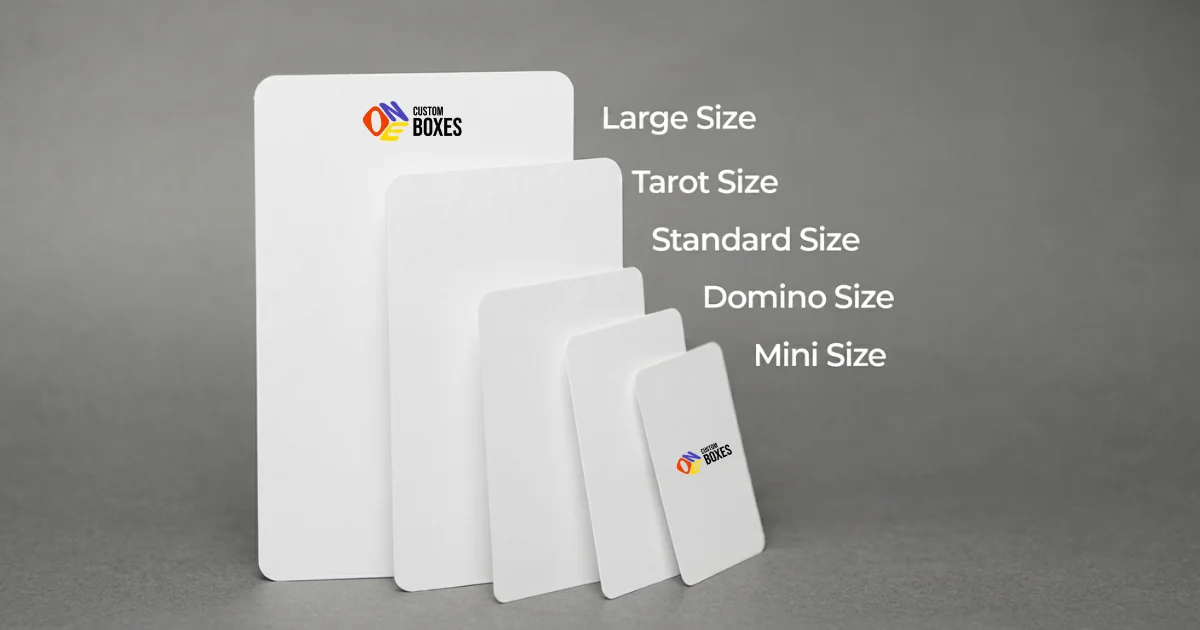
The table below lists every commercially produced playing card format currently in circulation, with dimensions in both inches and millimeters and the primary use case for each.
| Card Type | Inches (W × H) | Millimeters (W × H) | Primary Use |
|---|---|---|---|
| Miniature | 1.75 × 2.5 | 44 × 64 | Travel decks, novelty, collectibles |
| Bridge | 2.25 × 3.5 | 57 × 89 | Bridge and trick-taking games |
| Poker (standard) | 2.5 × 3.5 | 63.5 × 89 | Poker, blackjack, most card games |
| European | 2.4 × 3.8 | 61 × 97 | Continental European card games |
| Tarot | 2.75 × 4.75 | 70 × 120 | Tarot reading, oracle decks |
| Trump | 2.44 × 3.94 | 62 × 100 | Trump-suit card games |
| Educational | 3.5 × 5.75 | 89 × 146 | Classroom, learning tools |
| Flash cards | 4.1 × 5.8 | 105 × 148.5 | Study, memorization, training |
| Double poker | 3.5 × 5.0 | 89 × 127 | Novelty, promotional, accessibility |
| Jumbo | A5 / A4 and up | 148 × 210+ | Events, stage, marketing |
| Place cards (folded) | 3.5 × 2.0 | 89 × 51 | Wedding, formal dining, events |
Poker Cards: The Universal Format
Dimensions: 2.5 × 3.5 inches (63.5 × 88.9 mm)
Poker-size cards became the global standard because they balance three competing requirements: comfortable hand-feel across a wide range of adult hand sizes, sufficient vertical space for legible suit and value indices, and a fan spread that allows a player to view a hand without exposing cards to opponents. Every major card game played with a standard deck Texas Hold’em, blackjack, rummy, solitaire uses this format.
A stacked 52-card poker deck measures approximately 0.75 inches (19 mm) in thickness. Adding jokers and a rules card brings the total to about 0.78 inches (20 mm). These stack measurements determine the required inner depth of any tuck box, hinged case, or rigid packaging designed for the format.
Custom deck designers rarely have a strong reason to deviate from poker size. Standard dimensions guarantee compatibility with the widest range of card sleeves, produce the most competitive printing costs, and provide the most familiar tactile experience for end users.
Bridge Cards: Narrower for Large Hands
Dimensions: 2.25 × 3.5 inches (57 × 89 mm)
Bridge cards share the same height as poker cards but reduce the width by a quarter inch. That difference addresses a specific ergonomic problem: bridge is played with 13-card hands, and fanning 13 cards at poker width creates hand fatigue during extended play while requiring wider spreads that risk exposing cards to opponents.
The narrower format produces a tighter fan geometry, reduces strain, and keeps the hand more compact. Spades, hearts, and pinochle players often prefer bridge-width cards for the same reason any game with large simultaneous hands benefits from the reduced width.
Because bridge and poker cards share the same height, they use tuck boxes of identical height but different width. A poker-width tuck box holding bridge cards will allow the cards to shift during shipping, which damages edges over time and creates a loose, low-quality feel when the box is opened.
Tarot and Oversized Formats
Dimensions: 2.75 × 4.75 inches (70 × 120 mm)
Tarot cards carry approximately 50 percent more surface area than standard playing cards, and that additional space directly serves their function. A standard tarot deck contains 78 cards featuring detailed symbolic artwork figures, astrological references, elemental imagery, and narrative composition that would lose legibility at poker size.
The larger format also matches the handling context. Tarot cards are shuffled as a deck, drawn individually, and laid in spreads on a flat surface rather than held in a fanned hand. Because the user never needs to hold all 78 cards simultaneously, the ergonomic constraints that limit playing card size do not apply.
A 78-card tarot deck typically stacks to 1.0–1.2 inches (25–30 mm) depending on card stock. Packaging must account for this greater depth standard poker tuck boxes cannot accommodate tarot decks in any orientation, and the extra weight often calls for reinforced tuck construction or rigid box formats to maintain structural integrity through repeated use.
European and Regional Formats
European playing cards: 2.4 × 3.8 inches (61 × 97 mm)
Continental European cards used across France, Germany, Austria, and much of Eastern Europe are slightly narrower and noticeably taller than American poker cards. The additional height creates a more elongated visual proportion and a different fan geometry when held in the hand.
Traditional German games such as Skat, Schafkopf, and Doppelkopf are designed specifically around these proportions. Game mechanics developed over centuries assume this card geometry, and while changing dimensions does not affect rule application, it can subtly affect the tactile experience regular players expect.
Trump cards: 2.44 × 3.94 inches (62 × 100 mm) used for European trump-suit games, offering an elongated proportion suited to the bold, high-contrast artwork typical of these decks.
Miniature, Place Cards, and Specialty Sizes
Miniature cards 1.75 × 2.5 inches (44 × 64 mm)
Miniature decks cover roughly 60 percent of standard poker card area and exist primarily for portability travel games, novelty gift sets, promotional giveaways, and pocket decks. The reduced size introduces a design challenge: suit symbols, court card artwork, and number indices must remain legible at reduced scale, which requires thicker line weights, proportionally larger indices, and simplified artwork rather than direct downscaling.
A design that works at poker size will rarely translate well when scaled to miniature format. Best practice is to design at the target size from the beginning, treating miniature as a distinct format rather than a shrunken version of the standard.
Place cards 3.5 × 2.0 inches folded (89 × 51 mm)
Place cards are folded tent-style cards used for table seating identification at weddings, formal dinners, and corporate events. The unfolded dimension is 3.5 × 4.0 inches, scored and folded at the midpoint so the card stands upright. Custom-printed place cards with calligraphy-style fonts and premium card stock represent a distinct segment of event stationery.
Flash cards 4.1 × 5.8 inches (105 × 148.5 mm)
Flash cards correspond closely to A6 paper format, which is not accidental the size takes advantage of standard paper cutting dimensions to keep production costs low at educational volumes. The format is designed for one-side-prompt, one-side-answer interaction at normal reading distance.
Educational cards 3.5 × 5.75 inches (89 × 146 mm)
Larger than flash cards, educational cards provide space for images, text, and diagrams used in classroom instruction. Recommended minimum font sizes are 18pt for body text and 24pt for primary content to ensure readability at typical classroom viewing distances.
Double poker cards 3.5 × 5.0 inches (89 × 127 mm)
Approximately twice the area of standard poker cards, double poker cards serve novelty applications, promotional products, and accessibility-focused card sets for players with visual impairment or motor limitations that make standard sizes difficult to handle.
Jumbo Cards for Events and Demonstrations
Dimensions: A5 (148 × 210 mm), A4 (210 × 297 mm), or larger
Jumbo cards function as visual props rather than playable cards. At A4 size and above, they cannot be shuffled, fanned, or handled like actual playing cards. Applications include stage magic performances, event entertainment, marketing displays, educational demonstrations, and photo opportunities at corporate events.
Because these cards are viewed at distance, design priorities differ from standard cards. Indices must be readable from 20 feet or more, requiring bold, high-contrast artwork rather than fine detail. Card stock should be minimum 350gsm board or mounted on rigid substrate standard playing card stock at jumbo dimensions will bend under its own weight and fail to maintain the flat presentation the format requires.
Custom Board Game and Tabletop Formats
Modern board game and card game design has expanded well beyond the poker and bridge standards. Contemporary tabletop games use card sizes selected to serve specific gameplay functions resource tokens, character sheets, timeline mechanics, tile-like placement, and more. Common custom sizes include:
- Mini Euro: 44 × 68 mm often used for secondary card decks in Eurogames.
- Standard Euro: 59 × 92 mm close to bridge size, common for main game decks in European game design.
- Standard American: 56 × 87 mm slightly smaller than bridge, used in many published game titles.
- Tarot size (game use): 70 × 120 mm used for large-format cards with extensive text or artwork.
- Square cards: 70 × 70 mm or 80 × 80 mm used for tile mechanics in modern board games.
Custom die-cuts add cost compared to standard formats. Before finalizing a non-standard card size, confirm the target printer’s supported cutting dimensions and press sheet layout efficiency, as some sizes create significant waste that raises per-unit cost.
Dominion cards the deck-building game that essentially defined the modern genre use standard poker size (2.5 × 3.5 inches) specifically to ensure compatibility with widely available card sleeves. Because deck-building gameplay involves shuffling cards hundreds of times over a game’s lifespan, sleeve compatibility is a functional requirement rather than a preference.
Card Stock Thickness and Finish

Card thickness receives less attention than dimensions but often matters more for perceived quality. Stock that is too thin feels flimsy; stock that is too thick will not shuffle smoothly. The right thickness produces cards that feel responsive, substantial, and durable across thousands of uses.
Four card stock specifications cover the majority of professional playing card production:
| Stock | Thickness | Core | Finish | Best Suited For |
|---|---|---|---|---|
| Gaming Linen | ≈0.33 mm | Blue core | Linen texture | Board games and card games |
| Premium Smooth | ≈0.33 mm | Blue core | Smooth | Photo printing, wedding, premium brands |
| Deluxe Smooth | ≈0.31 mm | Standard | Ultra-smooth | Luxury decks, collector editions |
| Casino Linen | ≈0.31 mm | Dark core | Air-pocket linen | Casino, tournament, professional play |
Why blue and dark cores matter
Both blue-core and dark-core papers exist to prevent light from passing through the card and revealing what is printed on the reverse. Without a light-blocking core, holding a card near a bright light source can produce visible shadows of the other side’s artwork a functional defect in any game where hidden information matters.
Blue cores handle most consumer and gaming applications adequately. Dark cores provide near-total opacity and are the standard for casino-grade cards where absolute concealment is required.
Linen versus smooth finishes
Linen finishes create a fine textured surface that improves card-to-card separation during shuffling and reduces the sticking that smooth cards can experience in humid conditions. Smooth finishes reproduce photographic detail more sharply and render color more accurately, making them the better choice for artwork-driven decks where visual fidelity is the priority.
Packaging and Tuck Box Dimensions
Packaging dimensions receive less attention than card dimensions but often determine whether a finished product feels professional or amateur. A well-fitted tuck box holds the card stack firmly without binding on removal. A poorly fitted box either compresses the deck or allows it to shift during shipping, which damages card edges and creates a low-quality first impression.
| Card Format | Recommended Tuck Box (inches) | Notes |
|---|---|---|
| Poker (52 cards) | 2.6 × 3.6 × 0.8 | Standard tuck box with thumb-cut |
| Bridge (52 cards) | 2.4 × 3.6 × 0.8 | Narrower width, same height as poker |
| Tarot (78 cards) | 2.9 × 4.9 × 1.2 | Reinforced tuck or rigid box recommended |
| Mini (52 cards) | 1.9 × 2.6 × 0.7 | Compact tuck, flip-top lid common |
| Custom (variable) | Specify per design | Add 0.1″ clearance per dimension |
Clearance rule: Add approximately 0.05–0.10 inches (1.3–2.5 mm) of clearance between the card stack and the inner box dimension on all three axes. Tighter clearance causes cards to bind and resist removal. Looser clearance allows cards to shift, which damages edges and communicates poor build quality.
Interactive Tuck Box Dimension Calculator
Enter card dimensions, deck count, and card stock thickness to calculate the recommended tuck box size with proper clearance applied.
Deck stack thickness: ≈ 0.68″ (17.2 mm)
Clearance applied: +0.10″ on width, height, and depth
How to Choose the Right Card Size

The correct card size depends on the handling context, the amount of information printed on each card, sleeve compatibility requirements for the target audience, and the packaging plan. Five practical questions typically resolve the decision:
- How many cards will a player hold at once? Large hands (13+ cards) call for bridge width. Small hands (5–7 cards) work well at poker width. Table-play games without held hands can use larger formats.
- How much information appears on each card? Minimal information (suits, values) fits any size down to miniature. Extensive text, complex artwork, or multiple abilities require larger formats to remain legible.
- Will players use card sleeves? Board game and CCG audiences generally do. Standard sizes ensure sleeve availability; non-standard sizes force users to source custom sleeves, adding purchase friction.
- What card stock and finish suit the use case? Linen finishes for games with heavy shuffling. Smooth finishes when visual quality is the priority. Casino-grade stock for professional or tournament use.
- What packaging is planned? Specify packaging dimensions alongside card dimensions during initial design, not after cards are already in production. Mismatched packaging is one of the most common and expensive custom card production errors.