
Boost Your Brand with our Custom Packaging!
You’re here because your product is sitting on a retail shelf somewhere, blending into the background, getting overlooked while competitors get picked up first. Or maybe you’re about to enter retail for the first time and you want to make sure that doesn’t happen.
Either way, the problem is the same: standard packaging wasn’t designed to sell. It was designed to hold.
Display packaging is fundamentally different. It’s built to showcase, to attract, to convert a casual browser into a buyer within the 3 to 7 seconds you have before they walk past. It’s not just a box. It’s a point-of-sale marketing tool that works every hour the store is open without asking for a salary.
This page is going to walk you through everything you actually need to know before ordering display packaging. What types exist, which one fits your product and retail environment, what materials work best, what it costs, what mistakes to avoid, and how to get retailers to actually accept and place your displays. Not sales fluff. Practical information you can use to make a smart decision.
5,000+ brands big and small 🥰 love us! ★ ★ ★ ★ ★ 5.0 Google Reviews
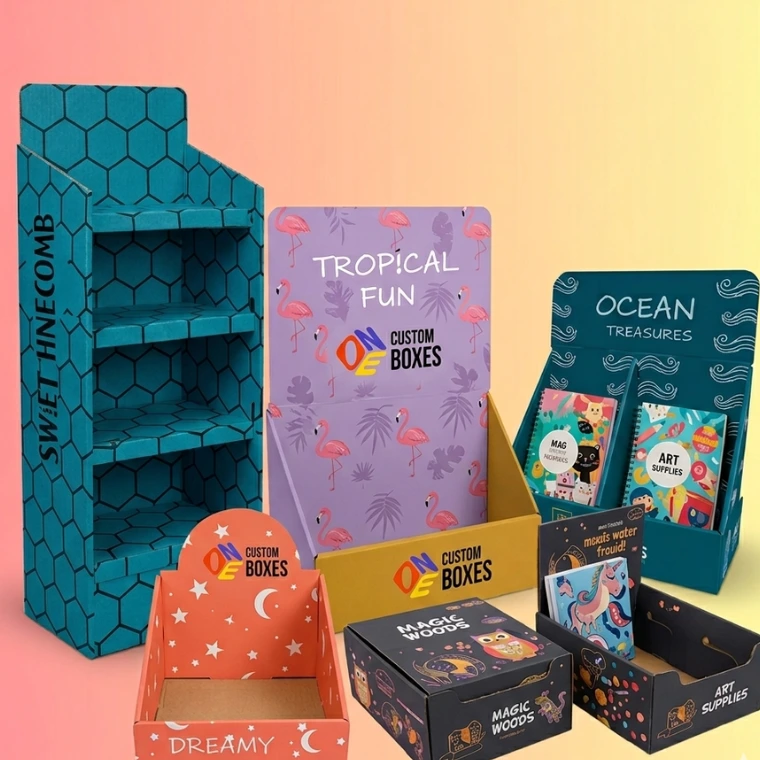
Before picking a display type, you need to answer one question honestly: where is your product going to live in the store, and what’s working against it right now?
Different retail problems need different display solutions. Here’s how to match your situation to the right approach:
Solution: Shelf-Ready Packaging (SRP) or Shelf Trays
Your product is already on the shelf but it’s getting buried between competitors. Shelf-ready display trays elevate your products slightly, group them together with your branding visible, and create a “branded block” on the shelf that catches the eye.
Solution: Counter Display Boxes
Small, compact units that sit on countertops near the register. Customers are standing there waiting, wallet already out, mentally in “buying mode.” A well-placed counter display with the right product at the right price point converts at incredibly high rates.
Solution: Floor Display Stands
Free-standing units that don’t depend on existing shelf space at all. You’re essentially creating a mini branded store-within-a-store. Placed in high-traffic aisles, end caps, or near store entrances, these command attention in ways shelf placement never can.
Solution: Window Display Boxes
Die-cut openings that let shoppers see the actual product without opening anything. Critical for products where color, texture, or visual appearance drives the purchase decision. Cosmetics, food items, toys, artisan products.
Solution: Pop-Up Display Stands
Ships flat, assembles in seconds, looks professional. Designed for temporary retail activations, seasonal pushes, trade shows, and promotional events. Use it for two weeks, then recycle it. Cost-effective and impactful.
Solution: Hanging Display Packaging (Peg Hook / Euro Slot)
Products that are too small for shelf placement but need visibility. Hang them on retail walls or display racks. Batteries, hair accessories, small snack packs, phone accessories, travel-size products.
Solution: Tiered / Multi-Level Display Stands
Products arranged on cascading tiers so every SKU in your line is visible simultaneously. No product hides behind another. Each level catches the eye at a different angle, which is especially useful in stores with heavy foot traffic from multiple directions.
Display Packaging Types: Detailed Breakdown
The workhorse of impulse retail. These sit on checkout counters, reception desks, service counters, and point-of-sale areas where customers are already standing with nothing to do but look around.
Typical Dimensions: 8″ to 16″ wide, 6″ to 12″ deep, 8″ to 18″ tall (varies by product)
Ideal Products:
Material Recommendation: 350-400 GSM SBS cardboard for lightweight products. E-flute corrugated for slightly heavier items. Both print beautifully and hold structure on countertops.
Key Design Consideration: The front panel is everything. Customers see counter displays at eye level from about 2 to 4 feet away. Your branding, product name, and price point need to be readable from that distance instantly. Don’t clutter it.
Capacity Planning: Design your display to hold 2 to 3 days worth of stock at average sell-through rate. Too many products crammed in looks messy. Too few looks like the product isn’t selling. Hit the sweet spot.
The big guns. Free-standing units that create dedicated brand real estate inside someone else’s store. These are what major brands use for new product launches, seasonal campaigns, and high-visibility retail pushes.
Typical Dimensions: 18″ to 24″ wide, 14″ to 20″ deep, 48″ to 72″ tall
Ideal Products:
Material Recommendation: B-flute or BC-flute corrugated cardboard. Floor stands need to support significant weight and withstand being bumped by shopping carts, restocked repeatedly, and standing for weeks or months. Double-wall corrugated for heavy product loads. Printed outer wrap or direct litho-laminated printing for brand graphics.
Key Design Consideration: Floor displays get viewed from 6 to 10 feet away initially. Your header card (the top panel) needs to communicate your brand and key message from that distance. Think of it as a mini billboard. Bold graphics, large logo, clear product category identification. The closer someone walks, the more detail they can absorb from the lower panels.
Structural Tip: Include a reinforced base that distributes weight evenly. Nothing kills a floor display faster than a sagging or tilting base after a few days. We use double-wall corrugated bases with internal support ribs for anything over 15 pounds total product load.
This is what Walmart, Target, Costco, and major grocery chains increasingly require from suppliers. The concept is simple: your product ships in a tray or box that converts directly into a shelf display. Tear off the top, put it on the shelf, done.
Typical Dimensions: Sized to fit standard retail shelf depths (typically 12″, 16″, or 24″ deep shelves)
Ideal Products:
Material Recommendation: E-flute or B-flute corrugated. Needs to be sturdy enough to survive shipping as a case pack AND look clean enough to serve as a shelf display. Litho-laminated print wraps deliver the best visual quality on corrugated.
Key Design Consideration: SRP has two jobs: protect products during shipping and look presentable on the shelf. The perforated tear-away top must tear cleanly every single time. Ragged, uneven tear lines make your display look damaged and unprofessional. We laser-cut our perforation lines for clean, consistent tears.
Why Retailers Love SRP:
Why You Should Love SRP:
Die-cut openings that let customers see the actual product inside the packaging without opening, touching, or damaging it. The product sells itself visually.
Typical Applications:
Window Options:
| Window Type | Description | Best For |
| Clear PVC/PET Window | Transparent plastic film over die-cut opening | Products that need physical protection behind the window |
| Open Window (No Film) | Die-cut opening with no covering | Products where touch/smell matters (soaps, candles, baked goods) |
| Acetate Window | Biodegradable transparent film | Eco-conscious brands wanting window display without plastic |
| Shaped Window | Custom die-cut shapes (circles, product silhouettes, brand icons) | Brands wanting unique visual identity on shelf |
Key Design Consideration: The window should show the BEST part of your product. Sounds obvious, but we’ve seen boxes where the window shows the product label instead of the product itself, or where the product shifts inside the box so the window shows empty space. Design the window placement and the internal product positioning together.
Flat-packed displays that ship efficiently and assemble in seconds without tools. Designed for temporary retail activations, events, trade shows, and seasonal campaigns where permanence isn’t the goal but impact absolutely is.
Typical Use Cases:
Material Recommendation: E-flute or B-flute corrugated with high-quality print finish. Needs to look professional despite being temporary. Matte or gloss lamination recommended to protect graphics during repeated handling.
Key Design Consideration: Assembly instructions need to be idiot-proof. Seriously. The person setting up your display at a trade show or a retail store is not going to spend 20 minutes figuring it out. If it takes more than 60 seconds to assemble, it’s too complicated. We design pop-ups with pre-folded joints and lock-tab assembly. No tape, no glue, no confusion.
Shipping Advantage: Pop-up displays ship flat, which dramatically reduces shipping costs compared to pre-assembled floor stands. A display that measures 48″ x 24″ x 18″ assembled might ship as a flat pack measuring 48″ x 24″ x 3″. That’s a massive difference in dimensional weight shipping costs.
Packaging designed with euro slots or peg hooks for wall-mounted retail displays. Maximizes vertical merchandising space and keeps small products organized and visible.
Typical Dimensions: Product-specific, with standard euro slot dimensions (1.5″ x 0.75″ slot, positioned center-top)
Ideal Products:
Material Recommendation: 350-400 GSM cardboard with header card. The header card carries your branding and product info. The product attaches to or sits within the lower portion. Blister packs with cardboard backing are common for small hard goods.
Key Design Consideration: The header card is the only thing visible when products are hanging side by side on a retail wall. It needs to communicate brand, product name, and key selling point in a space that’s typically only 3″ to 4″ wide. Every square millimeter counts. Prioritize ruthlessly.
Cascading multi-level displays that show multiple products or SKUs on different tiers, each visible simultaneously without stacking or blocking each other.
Typical Applications:
Material Recommendation: Corrugated cardboard with reinforced shelves for heavier products. Cardboard/SBS for lightweight items like cards or cosmetics. Rigid board for permanent or semi-permanent luxury displays.
Key Design Consideration: Each tier must be angled correctly to show product faces, not product tops. The angle depends on the typical viewing height. Counter displays (viewed from above at 5 to 6 feet) need steeper tier angles. Floor displays (viewed straight on at 4 to 5 feet) need more gradual angles. Getting this wrong means customers see a bunch of product tops instead of product fronts, which kills the entire purpose.
| Material | Best Display Types | Weight Capacity | Print Quality | Durability | Cost |
| SBS Cardboard (300-450 GSM) | Counter displays, window boxes, hanging packaging | Light (under 5 lbs total) | Excellent | Moderate | $$ |
| E-Flute Corrugated | Counter displays, SRP, pop-ups, small floor stands | Moderate (5-15 lbs) | Good (litho-lam: excellent) | Good | $$ |
| B-Flute Corrugated | Floor stands, large SRP, heavy-duty counter displays | Heavy (15-40 lbs) | Good (litho-lam: excellent) | High | $$ |
| BC-Flute (Double Wall) | Large floor stands, heavy product displays | Very Heavy (40+ lbs) | Good (litho-lam: excellent) | Very High | $$$ |
| Kraft Corrugated | Eco-focused displays, farmers market, organic brands | Moderate to Heavy | Good (natural brown shows through) | High | $$ |
| Rigid Board | Permanent/semi-permanent luxury displays | Moderate | Excellent | Very High | $$$$ |
Most corrugated cardboard has a slightly rough, textured surface that doesn’t print as sharply as smooth cardboard. Litho-lamination solves this by printing your graphics on a smooth paper sheet first, then laminating that printed sheet onto the corrugated structure.
Result: You get the structural strength of corrugated WITH the print quality of smooth cardboard. This is the industry standard for high-quality floor displays and branded SRP. If your display is going into a major retail environment, litho-laminated corrugated is almost always the right call.
This is the part nobody talks about. You can design the most beautiful floor stand in the world, but if the retailer won’t place it in their store, it’s worthless.
Retailers care about three things:
| Gets Accepted | Gets Rejected |
| Clean, professional print quality | Cheap-looking, low-resolution graphics |
| Easy assembly (under 2 minutes) | Complex assembly requiring tools |
| Appropriate size for the store format | Oversized displays that block aisles |
| Products that match the store’s customer base | Random product placement in wrong store types |
| Sturdy construction that lasts the planned duration | Flimsy displays that collapse within a week |
| Pre-stocked and ready to place | Empty displays requiring immediate stocking labor |
| Planogram-compliant SRP (for major chains) | Non-standard sizes that don’t fit shelf layouts |
Your display has approximately 3 seconds to catch someone’s attention as they walk through a store. In those 3 seconds, it needs to:
That’s it. Not your full brand story. Not your 15 product features. Not your company history. Just: notice me, understand what I am, come closer.
Everything else happens after they’ve walked closer. The secondary messaging, the product details, the pricing, the calls to action, all of that lives on the lower panels and the product-level packaging. The header and upper portion of your display exists solely to pass the 3-second test.
The most common display packaging failure is designing in isolation. Your display looks great in a mockup against a white background on your screen. But in a store, it’s surrounded by other products, other displays, fluorescent lighting, patterned flooring, and visual noise everywhere.
Design for the actual environment, not the mockup.
If the store has warm lighting, cool-toned displays stand out more. If the category aisle is dominated by blue packaging (common in oral care and cleaning products), a red or orange display pops. If every competitor uses busy, complex graphics, a clean, minimalist display stands out through simplicity.
Before finalizing your design, ask: “What will be AROUND this display in the store?” Then design to contrast with that environment.
Header (viewed from 6 to 10 feet):
Mid-section (viewed from 3 to 5 feet):
Product level (viewed from 1 to 2 feet):
Small structural choices communicate quality:
Customers don’t consciously evaluate these things. But subconsciously, a display that looks solid and well-made transfers that quality perception to the product it holds.
Your display mockup on a computer screen looks incredible. But in a store with fluorescent lights, surrounded by visual clutter, from 8 feet away, the details disappear and the colors shift. Always evaluate your design in the context of its physical retail environment. Order a physical prototype and place it in the actual store (or a similar environment) before committing to production.
“It held 30 units in our warehouse, so it’s fine.” Is it fine after a week of customers grabbing and replacing products? After being bumped by shopping carts? After the air conditioning fluctuates humidity levels? Material fatigue is real. Design for 125% of your maximum product load to account for wear over time.
A beautifully designed display that requires carefully arranging each product in a specific orientation will look great on Day 1 and terrible on Day 3 after a busy store employee restocks it in 20 seconds without reading your placement guide. Design your display so products look good regardless of how they’re placed inside. Dividers and compartments help.
Floor displays over 60 inches tall create sightline problems in stores. Retailers want customers to be able to see across aisles for both aesthetics and security reasons. Going too wide blocks aisle flow and violates fire codes in many jurisdictions. Stay within standard retail dimensional guidelines: 48 to 60 inches tall, 18 to 24 inches wide for floor stands. Always confirm with the retailer.
You designed it on CAD software. It looks great in the 3D render. But can a store employee who’s never seen it before assemble it in under 2 minutes with no instructions? If no, it’s too complicated. Send a prototype to someone unfamiliar with the design and time them. If they struggle, simplify.
Your display grabs attention, shows the product, communicates the brand. But it never tells the customer what to do next. “Try Our New Flavor,” “Limited Edition: Only While Supplies Last,” “Scan for $2 Off Coupon.” A clear, simple call to action on the display consistently outperforms displays without one. Don’t assume the product sells itself. Give customers a nudge.
What drives the price of display packaging? Here’s the transparent breakdown:
| Factor | Impact on Price |
| Display Type | Counter displays are cheapest. Floor stands cost more. Permanent rigid displays cost most. |
| Size | Bigger displays use more material. Direct correlation. |
| Material | SBS cardboard is affordable. Corrugated is mid-range. Rigid board is premium pricing. |
| Corrugated Flute Type | E-flute (thinner, lighter, cheaper). B-flute (thicker, sturdier, slightly more). Double-wall (strongest, highest cost). |
| Print Method | Direct print on corrugated is cheapest. Litho-lamination is mid-range. Wrap-around print on rigid is highest. |
| Finishing | Matte/gloss lamination is standard. Spot UV, foil stamping, embossing each add cost. |
| Structural Complexity | Simple one-piece displays are cheapest. Multi-tiered, multi-component displays with shelves and dividers cost more. |
| Quantity | Per-unit cost drops significantly with higher volumes. Die and plate setup costs get spread across more units. |
| Pre-Loading | If we pre-load products into displays before shipping, assembly labor adds to cost but saves you and the retailer time. |
| Display Type | Price Range (per unit at 250+ qty) |
| Counter display box (basic) | $2.50 to $6.00 |
| Counter display box (premium finish) | $5.00 to $12.00 |
| Floor stand (single-sided) | $15.00 to $35.00 |
| Floor stand (four-sided) | $30.00 to $65.00 |
| Shelf-ready tray (SRP) | $1.50 to $4.00 |
| Pop-up display | $8.00 to $25.00 |
| Hanging display card | $0.50 to $2.00 |
| Tiered counter display | $6.00 to $18.00 |
| Permanent rigid display | $40.00 to $150.00+ |
These are ballpark figures. Actual pricing depends on exact dimensions, materials, print specifications, and order quantity. Get a free custom quote for accurate numbers.
Best display types: Counter displays for impulse snacks near checkout. Floor stands for new product launches in grocery aisles. SRP for ongoing shelf presence.
Material consideration: Food-safe inks and coatings. FDA-compliant materials if product touches the display surface directly. Grease-resistant coatings for baked goods or oily snack packaging.
Design tip: Food photography drives conversion. High-quality product imagery on the header panel makes people hungry. That’s your advantage over non-food displays sharing the same visual space.
Best display types: Counter displays for cosmetic counters and beauty store registers. Tiered displays for shade ranges. Window displays for color-driven products.
Material consideration: SBS cardboard with premium finishes. Soft-touch lamination and foil stamping are expected in the beauty space. The display needs to feel as premium as the product.
Design tip: Beauty displays need to photograph well for social media. Stores frequently post their display setups online. Displays that look good on camera get free marketing exposure.
Best display types: Counter displays for pharmacies and health food stores. SRP for vitamin aisles. Small floor stands for new supplement launches.
Material consideration: Clean, clinical aesthetic. White cardboard with professional typography communicates trust and legitimacy. Avoid overly flashy designs, as health-conscious consumers prefer straightforward, credible-looking packaging.
Design tip: Include educational content on side panels. Health product buyers read more than average. Supplement facts highlights, sourcing information, or certification badges (organic, non-GMO, third-party tested) on the display build trust and justify pricing.
Best display types: Floor stands during holiday season. Counter displays for small collectibles. Window display boxes for action figures and dolls.
Material consideration: Bright, durable corrugated for floor stands. Heavy-duty because kids will touch, pull, and test the structural limits of your display. Reinforce everything.
Design tip: Design at child eye level, not adult eye level. If your target buyer is under 12, the compelling visuals need to be at 36 to 48 inches height, not 60 inches.
Best display types: Counter displays for phone cases, earbuds, chargers. Hanging displays for small accessories. SRP for retail chains.
Material consideration: Sleek, modern aesthetic. Black or dark gray cardboard with spot UV or metallic accents. The display should look as tech-forward as the product inside.
Design tip: Include a QR code on the display linking to product demos, reviews, or compatibility guides. Tech buyers want information before purchasing. Make it easy.
Best display types: Counter displays for dispensaries. Small floor stands for CBD specialty retailers. SRP for stores carrying CBD alongside mainstream products.
Material consideration: Professional, clean, wellness-oriented. Avoid the stereotypical “cannabis” aesthetic unless that’s your specific brand positioning. Kraft with minimal printing works well for natural positioning. White cardboard with matte finish for clinical positioning.
Design tip: Compliance information needs to be visible on the display itself, not just on individual product boxes. Include required warnings, THC/CBD content ranges, and QR codes for lab results directly on the display header or side panels.
Display packaging generates significant material usage, especially floor stands and large promotional displays. Here’s how to approach it responsibly:
All our display packaging is made from recyclable materials. Corrugated cardboard is already one of the most recycled materials on the planet with recovery rates above 90% in the US.
Soy-based inks are standard on all our display printing. Lower VOC emissions during production and easier de-inking during recycling.
Right-size your displays. Oversized displays waste material AND retail space. We design displays to the minimum footprint needed for your product capacity and visual impact goals.
Design for disassembly. When the campaign is over, your display should break down flat for easy recycling. No mixed materials (metal rivets in cardboard, plastic clips, non-recyclable adhesives) that contaminate the recycling stream.
Consider display lifespan in your material choices. A two-week promotional display doesn’t need heavy-duty double-wall corrugated. Using lighter materials for shorter campaigns reduces waste without compromising performance during the actual campaign window.
It depends on your product, store format, and placement location. Counter display boxes are the most popular and versatile option, ideal for impulse-buy products near checkout. For larger product ranges or new launches, floor display stands create dedicated brand space. For ongoing shelf presence in major retail chains, shelf-ready packaging (SRP) is increasingly the standard expectation.
Counter displays typically range from $2.50 to $12.00 per unit at quantities of 250 or more. Floor stands range from $15.00 to $65.00 depending on size and complexity. Shelf-ready trays are the most affordable at $1.50 to $4.00 per unit. Exact pricing depends on dimensions, material, print specifications, and quantity.
Shelf-ready packaging (also called retail-ready packaging) is designed to ship as a case pack and convert directly into a shelf display by removing the top portion. Retailers prefer it because it reduces stocking labor by 50% or more, speeds up shelf replenishment, and creates consistent branded shelf blocks. Major chains like Walmart and Target increasingly require SRP from their suppliers.
B-flute or BC-flute corrugated cardboard for most applications. B-flute handles 15 to 40 pounds of product weight. Double-wall (BC-flute) handles 40+ pounds. For the best print quality on corrugated, use litho-lamination, which bonds a smooth printed sheet onto the corrugated surface.
Absolutely. Corrugated cardboard has over 90% recovery rate for recycling in the US. Our displays use recyclable materials, soy-based inks, and are designed for easy disassembly and recycling. We also offer kraft corrugated options for brands emphasizing their environmental commitment.
No minimums. You can order as few as 25 units to test a single retail location before scaling. This is ideal for testing display effectiveness, getting retailer feedback, and refining your design before a large rollout.
Standard production is 8 to 10 business days after design approval. Rush options are available for time-sensitive retail deadlines or promotional campaigns. Free shipping anywhere in the USA.
Yes. If you have a complete design, we’ll produce it. If you have a concept, we’ll refine it. If you’re starting from zero, our team will design it from scratch based on your product, brand guidelines, and retail placement goals. Design support is free.
Yes. If you send us your products, we can pre-load them into the displays before shipping. The retailer receives a ready-to-place unit that they can put directly on the floor or counter without any stocking work. This significantly increases the likelihood of your display being placed promptly.
Design the display to the retailer’s specifications (ask them first). Ship it pre-loaded and ready to place. Include a restocking plan. Size it appropriately for their store format. And most importantly, make sure the product itself has proven or projected sell-through rates that justify the retail space. Retailers are business people. Show them it will make money.
You know your product. You know your retail environment. You know which display type fits your situation.
Here’s how we make it happen:
No minimums. No hidden fees. No generic templates. Display packaging designed specifically for your product, your brand, and your retail environment.
Get your free quote today.
At the core of every partnership we forge is quality and trust—here’s what our clients have to say about working with us.